
Caif Native Oaks
Residential Landscape Restoration and Management Guidelines
Native oaks with natural woodland conditions have had some profound things going on, for centuries:
- foliar canopies all the way to the ground, creating a favorable microclimate underneath, shading the woody branch structure and the soil surface.
- several inches of mulch created by accumulation of leaf, twig and fallen branch litter.
- natural abundant soil biological activity with an established mycorrhizal fungal-root associations creating a healthy rhizosome.
- complete natural ecology with thousands or millions of macro and micro organisms active in the foliar canopy, leaf surfaces, twigs, woody branch and trunk and root structures.
Unfortunately for the trees, what’s been going on for 100 years and more is property development and environmental impacts that disturb and destroy these natural conditions, including severe encroachment into the structural and absorbing root zones, construction impacts, poor landscape design, incompatible plantings, disastrous water management, ill-informed landscape designers, gardeners, pest control operators using high-NPK high-salt-index fertilizers and other chemical treatments, which along with poor conditions and management, disrupt and destroy the all-important “soil-food-web” and beneficial biology.
Oak woodland trees with natural conditions may not need watering and fertilization. Native oaks in built environments do in fact need serious consideration for the needs of positive intervention.
It should always start with assessment and correction of the growing conditions, compatible plantings and irrigation, intelligent soil and water management. Appropriate treatment must be carefully considered, always site-by=site, tree-by-tree.
Throughout my 50 years as a tree health care specialist in the San Francisco-Monterey region, property development and harmful encroachment, incompatible plantings with poor irrigation practices are the most common causes of physiological stress, susceptibility to biotic and abiotic disorders, decline and mortality of native oaks that I have seen, far more prevalent than Sudden Oak Death and all other oak problems that I am called to assess in residential properties.
Unfortunately, many property owners, landscapers and arborists don’t ‘get it’, “don’t want to hear it”, they want their lawns and exotic plantings around the oaks and don’t recognize the damage that is being done over a 20- 30-year period.
What’s needed, if it’s not too late already, is outlined in the following authoritative papers. Especially this sound advice –
Stop all frequent (more than once a month) watering within the root zone or, at the very least, within ten feet of the trunk. Cap or adjust sprinklers as necessary.
“Compatible Plants Under and Around Oaks”
©1991 by the California Oak Foundation :
Principal Authors: Bruce W. Hagen, California Department of Forestry (ret.); Barrie D. Coate, Horticultural Consultant and
Consulting Arborist: Keith Oldham, Horticulturist and Arborist)
DISEASES
When growing under natural, undisturbed conditions, native California oaks typically resist most diseases. When weakened by disturbance and/or improper landscaping and irrigation, they become particularly susceptible to diseases. Two serious root diseases commonly encountered in irrigated settings are Crown Rot and Oak Root Fungus.
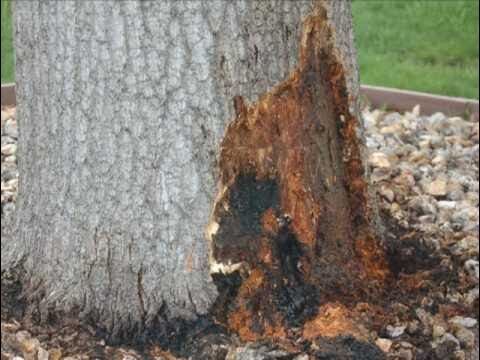
Crown Rot (Phytophthora spp.)
Crown Rot is one of the most common and serious problems of oaks in residential landscapes. Caused by a fungus-like soil-borne pathogen called a water-mold, it is fostered by excess moisture, poor drainage and inadequate soil aeration.
Symptoms and signs of this disease include:
- decline (general loss of vigor)
- reduced growth
- twig and branch die-back
- wilting
- chlorotic (yellow) foliage
- sparse and stunted foliage
- premature leaf drop
- formation of lesions on the bark of large roots and lower trunk accompanied by oozing of dark or rusty colored fluid.
In most cases, people notice the symptoms too late for successful treatment. However, if the disease is detected early, steps can be taken to save the tree. Treatment is best left to a certified arborist as homeowners are seldom equipped to deal with these problems. If a specialist cannot be called in, the following measures may be of benefit:
1. Stop all frequent (more than once a month) watering within the root zone or, at the very least, within ten feet of the trunk. Cap or adjust sprinklers as necessary.
2. Remove any soil, mulch or debris that has been placed or has accumulated against the trunk above the natural soil line.
3. If fill-soil has been placed around the tree, expose the tree’s flared base (root-collar), at the original soil line. By careful excavation of the soil the buried bark can dry. Remove soil within about one foot of the trunk and down until the large, buttress roots are exposed.
4. Leave the root-collar exposed. If necessary, provide drainage to prevent water from collecting around the root-crown during the winter. Cover the excavated area with a grate or decking if it is deep, or if you use the area around the tree.
CAUTION:
Trees that have had moist soil around their bases often develop decay in the root- crown. Such trees are often structurally weak and prone to fall, even if their tops appear healthy.
5. Allow turf in the unirrigated area to die and slowly decompose.
6. Remove ornamentals that require frequent irrigation.
7. Water drought tolerant plants no more than monthly. Hand water or use a soaker hose.
8. High-Nitrogen fertilization usually is not necessary and may encourage the disease or even slow recovery.