
Native oaks with natural woodland conditions have had some profound things going on, for centuries:
Unfortunately for the trees, what’s been going on for 100 years and more is property development and environmental impacts that disturb and destroy these natural conditions, including severe encroachment into the structural and absorbing root zones, construction impacts, poor landscape design, incompatible plantings, disastrous water management, ill-informed landscape designers, gardeners, pest control operators using high-NPK high-salt-index fertilizers and other chemical treatments, which along with poor conditions and management, disrupt and destroy the all-important “soil-food-web” and beneficial biology.
Oak woodland trees with natural conditions may not need watering and fertilization. Native oaks in built environments do in fact need serious consideration for the needs of positive intervention.
It should always start with assessment and correction of the growing conditions, compatible plantings and irrigation, intelligent soil and water management. Appropriate treatment must be carefully considered, always site-by=site, tree-by-tree.
Throughout my 50 years as a tree health care specialist in the San Francisco-Monterey region, property development and harmful encroachment, incompatible plantings with poor irrigation practices are the most common causes of physiological stress, susceptibility to biotic and abiotic disorders, decline and mortality of native oaks that I have seen, far more prevalent than Sudden Oak Death and all other oak problems that I am called to assess in residential properties.
Unfortunately, many property owners, landscapers and arborists don’t ‘get it’, “don’t want to hear it”, they want their lawns and exotic plantings around the oaks and don’t recognize the damage that is being done over a 20- 30-year period.
What’s needed, if it’s not too late already, is outlined in the following authoritative papers. Especially this sound advice –
Stop all frequent (more than once a month) watering within the root zone or, at the very least, within ten feet of the trunk. Cap or adjust sprinklers as necessary.
©1991 by the California Oak Foundation :
Principal Authors: Bruce W. Hagen, California Department of Forestry (ret.); Barrie D. Coate, Horticultural Consultant and
Consulting Arborist: Keith Oldham, Horticulturist and Arborist)
When growing under natural, undisturbed conditions, native California oaks typically resist most diseases. When weakened by disturbance and/or improper landscaping and irrigation, they become particularly susceptible to diseases. Two serious root diseases commonly encountered in irrigated settings are Crown Rot and Oak Root Fungus.
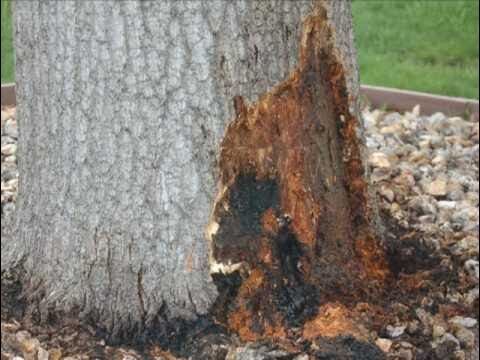
Crown Rot is one of the most common and serious problems of oaks in residential landscapes. Caused by a fungus-like soil-borne pathogen called a water-mold, it is fostered by excess moisture, poor drainage and inadequate soil aeration.
Symptoms and signs of this disease include:
In most cases, people notice the symptoms too late for successful treatment. However, if the disease is detected early, steps can be taken to save the tree. Treatment is best left to a certified arborist as homeowners are seldom equipped to deal with these problems. If a specialist cannot be called in, the following measures may be of benefit:
1. Stop all frequent (more than once a month) watering within the root zone or, at the very least, within ten feet of the trunk. Cap or adjust sprinklers as necessary.
2. Remove any soil, mulch or debris that has been placed or has accumulated against the trunk above the natural soil line.
3. If fill-soil has been placed around the tree, expose the tree’s flared base (root-collar), at the original soil line. By careful excavation of the soil the buried bark can dry. Remove soil within about one foot of the trunk and down until the large, buttress roots are exposed.
4. Leave the root-collar exposed. If necessary, provide drainage to prevent water from collecting around the root-crown during the winter. Cover the excavated area with a grate or decking if it is deep, or if you use the area around the tree.
Trees that have had moist soil around their bases often develop decay in the root- crown. Such trees are often structurally weak and prone to fall, even if their tops appear healthy.
5. Allow turf in the unirrigated area to die and slowly decompose.
6. Remove ornamentals that require frequent irrigation.
7. Water drought tolerant plants no more than monthly. Hand water or use a soaker hose.
8. High-Nitrogen fertilization usually is not necessary and may encourage the disease or even slow recovery.
Select plants that will tolerate the dry soils and partial shade typically found beneath native oaks during the summer. Many of California’s native plants are well suited to this environment; they are also attractive and pest resistant. These plants are available from nurseries specializing in native plants (see Nurseries). Many exotic species also perform well and are available at local nurseries. Plant ornamentals requiring full sun outside the dripline.
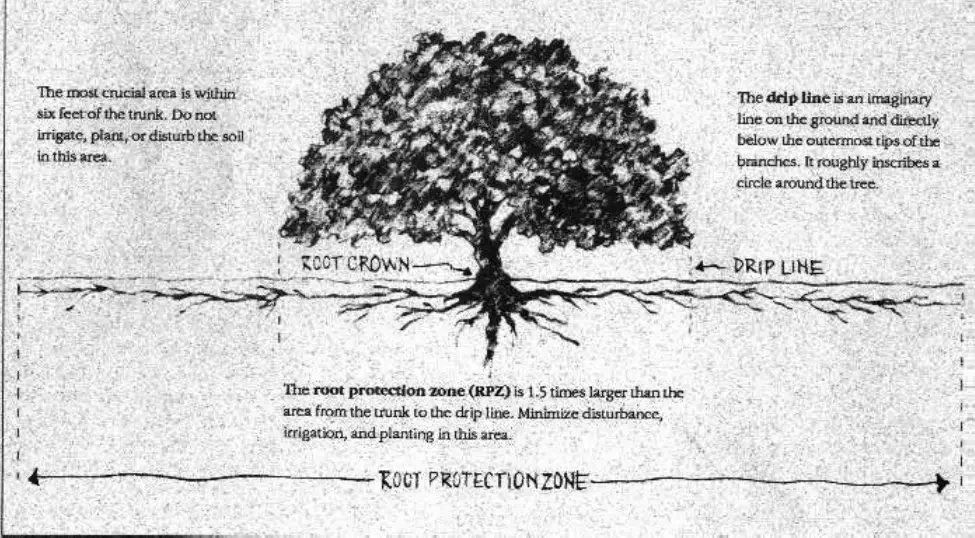
Only drought-tolerant plants that require no summer water should be planted around old established oaks, and they should be planted no closer than six feet from the base of the tree. Do not plant
exotic grasses, ivy, azaleas, rhododendrons, or any other vegetation that needs summer irrigation.
Such plants develop thick mats of roots and thus inhibit the exchange of air and water the established oak has grown used to.
There are a number of plants, some of which are native to California, that can be grown beneath oaks. For an extensive listing of compatible plants useful for landscaping around oaks, contact the California Oak Foundation.
In place of plants, other types of ground cover can be used to landscape beneath oaks. When installed properly, cobbles, gravel, and wood chips are good examples of ground covers that do not interfere with the roots’ ability to obtain oxygen and appropriate moisture.
Native oaks usually do not require irrigation as they are well adapted to dry summer conditions.
Healthy oaks are even able to survive the excessively dry summers sometimes brought on by California’s variable climate. But if an oak has been compromised, as when impervious surfaces have been placed in the root zone, occasional water may be helpful if done properly. Oaks should be irrigated only outside of the root protection zone. Persistent, moist, warm soil near the base of a mature oak promotes crown and root rot.
Irrigation, if done, should be by the “deep watering method,” which consists of a slow, all-day soaking only once or twice during the summer dry period. Frequent, shallow watering not only encourages crown and root rot, it also results in the growth of ineffective shallow roots near the surface, a needless waste of the tree’s energy.
If oaks need supplemental watering, it is best to apply the water at times that lengthen the normal rainy season, so the normal dry period in the middle to the end of summer is preserved. For
example, additional irrigation would be appropriate in May and September, while leaving the area under the tree dry in July and August.”
For management purposes, think of a tree’s root zone as extending out at least one-third farther than the distance to the dripline. This means no grading, digging, trenching, fill-soils, covering the ground with asphalt or concrete, or landscaping with plants that require more than two or three summer waterings.
It is preferable to retain natural litter (fallen leaves, twigs, and bark) or add mulch to cover the soil surface.
If the tree has bare ground in the absorbing root zone, raised canopy, over-pruning, soil compaction or pavement, incompatible plantings and wrong irrigation for a native oak, that should be the first line of corrections. Without correction of the basic growing conditions, no treatment, chemical or biological will help it significantly.
Don Cox